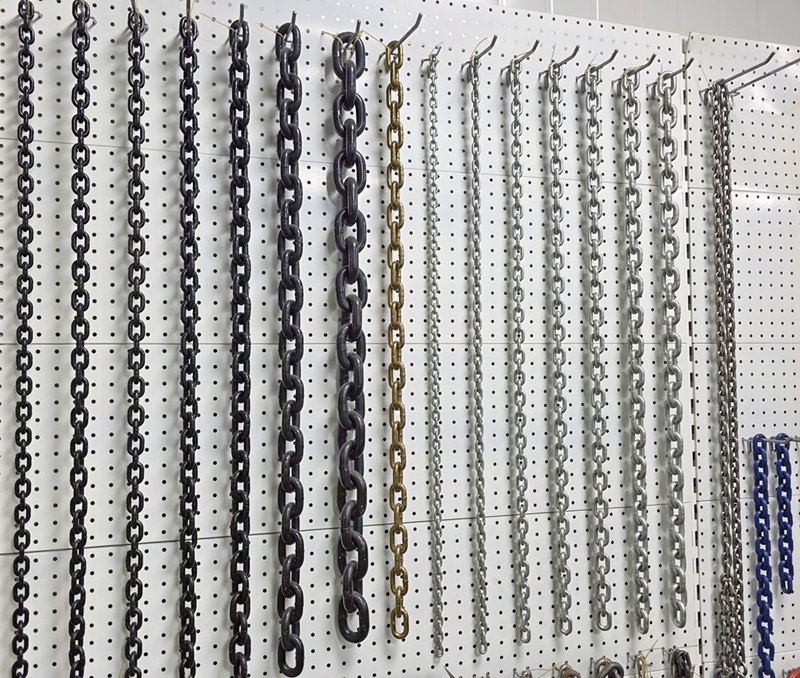

Manufacturing Process for Grade 80 Lifting Chains
2026-06-12
How are G80 chains manufactured?
Raw material inspection → bending & welding → first calibration → heat treatment → second calibration → proof load test → cutting → surface treatment → finished product inspection → packaging & warehousing.
1. Raw Material Inspection
When a batch of raw materials arrives at the chain factory, staff cut 10 cm samples for hardness testing, spectroscopic analysis and other tests to verify whether the chemical element composition meets specifications. Workers also conduct visual inspection of raw material surfaces. Production commences only after all materials pass inspection.
2. Chain Bending & Welding Production Line (need Chain Bending Machine and Chain Welding Machine)
Production is carried out in accordance with customer requirements. A chain bending machine forms the chain links, followed by welding to deliver smooth chain surfaces. A breaking load test is performed at this stage to verify the rated tensile load of the chains.
3. First Calibration (need Chain Calibration Machine)
Chains undergo first calibration to ensure all chain links comply with standards. Stamping (Marking) on chains for identification marks is also completed here as requested by customers, with all markings required to be clear and legible.
4. Heat Treatment (need Chain Heat Treatment Machine)
Galvanized lifting chains go through heat treatment (quenching and tempering) under dual frequency conversion and constant temperature control. This process improves the hardness and toughness of lifting chains. Additional sampling tests are conducted on cut chain sections to check surface hardness, breaking load and elongation for standard compliance.
5. Second Calibration (need Chain Calibration Machine)
Round lifting chains receive secondary straightening using samples of 5 or 7 links. The test load shall exceed 2.5 times the rated working load to confirm all chain dimensions match customer specifications.
6. Proof Load Test (need Proof Testing Machine)
Each 6-meter length of manganese steel lifting chain undergoes a tensile test at 2.5 times the rated load. This test verifies uniform performance across the full 6-meter chain length and evaluates the effectiveness of prior heat treatment.
7. Cutting to Length (need Chain Cutting Machine)
Chains are cut to custom lengths specified by customers (6m, 10m, 20m, etc.). A final breaking load test is performed on cut chains at this stage.
8. Surface Finishing
After cutting, high-temperature resistant lifting chains receive customized surface treatment as required by customers. Available finishes include polishing, black oxide coating, hot-dip galvanizing, electrophoretic coating and Dacromet coating. All surface treatments provide corrosion resistance, and customers select the appropriate finish based on their operating environment.
9. Finished Product Inspection
Once lifting chains are fully manufactured, the quality inspection department conducts comprehensive testing including hardness, tensile strength, breaking load and elongation rate to confirm compliance with all standards.
10. Packaging & Warehousing
Chains that pass all inspections are packaged and stored in warehouses. Packaging options include bulk ton bags, wooden cases, metal drums and plastic drums.
Frequently Asked Questions (FAQ) about G80 chains.
1. Q: What does G80 mean on a chain?
A: G80 refers to Grade 80, a high-strength industrial classification for alloy steel lifting chains. The letter G stands for "Grade", and the number 80 represents the chain's strength grade.
2. Q:What Is the difference between G80 and other chain grades?
A: G80 chains are is stronger than lower-grade chains such as G30, G43, G60. Only G80 and above grades are certified for professional overhead lifting work; lower-grade chains are merely for binding, securing and non-lifting use.
3. Q:What test standards must G80 chains pass?
A: All chains shall pass hardness test, breaking load test, elongation test, proof load test and so on.